The Future of the Akoya Pearl: What Japan Brought to Vicenzaoro 2026
In Vicenza this September, Japan's pearl exporters made a deliberate case to Europe: the Akoya is not only an heirloom to inherit, but a rare, modern material to design with. The numbers behind that case are striking.
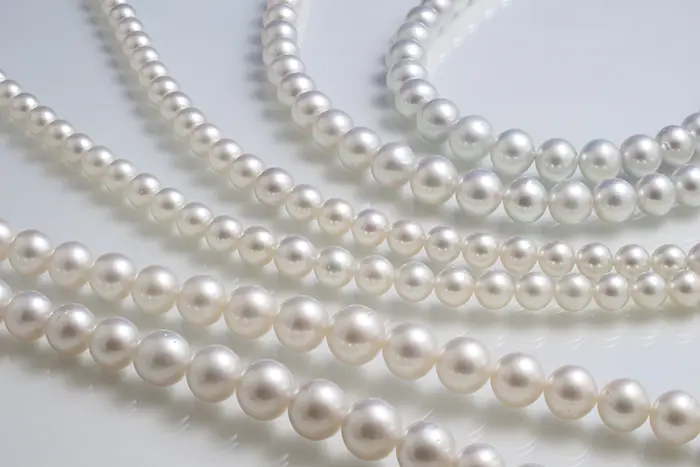
White pearl strands.
On a Sunday morning in September, in the Educational Hub of the Vicenza Expo Centre, the conversation turned to a pearl most of the room thought they already knew. The session was called "The Future of the Akoya Pearl: A Bridge Between Japan and the Global Jewellery Industry", and the title was the argument.
Japan's pearl exporters had come to Vicenzaoro to reintroduce the Akoya to the European and American markets — and, above all, to a younger generation, according to the show's organizer, Italian Exhibition Group.
What happened in Vicenza
The session opened at 10:30 on 6 September, the third day of Vicenzaoro September, which ran from 4 to 8 September. It was organized by Preziosa Magazine with senior figures from the Japan Pearl Exporters' Association (JPEA) and from the international jewelry trade, according to the show's programme.
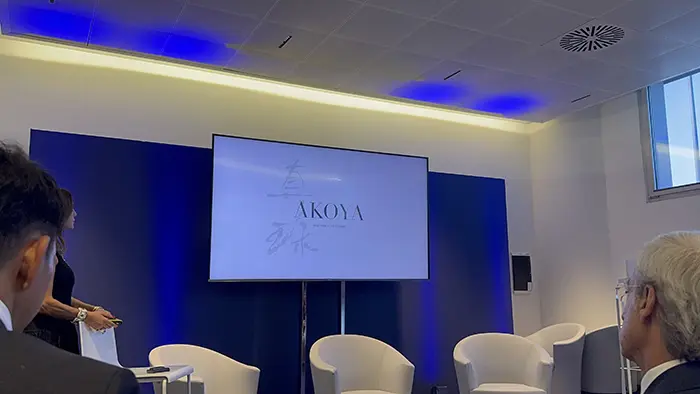
The Akoya session in the Educational Hub, Vicenzaoro, 6 September 2026.
Koji Yagi, Japan's Consul-General in Milan, opened it. He spoke of more than a century of ties between Japan and Italy — diplomacy and trade, but even more, culture and technology. The new Akoya story was given an Italian frame in a book, The Future of Akoya Pearl, edited by Paola De Luca, co-founder of Trendvision Jewellery + Forecasting.
George Kakuda, president of JPEA, set out the market case in conversation with Federica Frosini, editor-in-chief of VO+. Alfonso Vitiello of D'Elia Company and the designer Alessio Boschi explored the material's marketing and creative potential, IEG reported.

George Kakuda, president of the Japan Pearl Exporters' Association, on stage at Vicenzaoro.
The stage was a busy one. IEG counted 1,300 exhibiting brands from 40 countries at the September show, and 910 buyers from 73 countries — 33% more than a year earlier.
The argument, in brief
Kakuda's case, as IEG summarized it, runs in three steps. Rising sea temperatures are putting oysters under pressure and cutting production, which is already well below its level of twenty years ago. That structural limit on supply meets strong demand from China and growing interest from European brands. Together, they push the Akoya toward the high-end and luxury segments.
The official figures bear the first step out.
The numbers behind the story
|
Year |
Japan's pearl harvest |
|
1966, the peak |
130 tonnes |
|
1993 |
71.3 tonnes |
|
2011–2020 |
about 20 tonnes a year |
|
2024 |
12.8 tonnes |
Sources: Pearl Standard 2025, Japan Pearl Promotion Society; for 2024, agriculture ministry figures cited by JETRO.
The recent drop has a cause. Since 2019, mass die-offs of young Akoya oysters have struck Japan's main growing areas; a newly identified virus was named as the culprit in 2022, and prolonged high summer water temperatures add to the strain, according to the agriculture ministry and the Pearl Standard. Output has held near 12 tonnes a year since 2021, the Fisheries Agency reports.
Prices have moved the other way. The average unit price at Akoya joint sales nearly quadrupled between 2021 and 2024, and the price of newly harvested pearls passed its bubble-era level to reach an all-time high, the Pearl Standard records. In 2024, Japan's pearl output was worth ¥33.5 billion, as demand centered on China met a smaller harvest.
Exports tell the same story of concentration. Japan shipped ¥41.2 billion of pearls in 2024, and Hong Kong alone took 84% of export value in 2023, according to JETRO. The agriculture ministry is targeting ¥47.2 billion by 2030, and expanding into markets where Japanese pearls are still little known, such as the EU, is among the tasks JETRO lists.
Why Europe, why Vicenza
Read those numbers together and the choice of Vicenza makes sense. Asia already drives the trade. Europe is one of the markets where, by Japan's own account, Japanese pearls are still little known. And Italy brings what a scarce material needs most: designers and manufacturers who can turn it into objects people want.
The line-up made the same point. On stage were an editor, a trend forecaster, a jewelry company and a designer. That is the cast of a design conversation, not a price negotiation.
A pitch to a new generation
In Japan, the Akoya necklace was long a gift for formal occasions, handed from grandmother and mother to granddaughter and daughter — more a ceremonial necessity than a fashion piece, as the industry's own Pearl Standard puts it. The Vicenza message turns that around.
There are signs the ground is ready. JETRO notes that in the United States, pearls are becoming a fashion item rather than only a wedding one — worn by men as well as women, and across age groups. And the Akoya gives designers range: sizes mainly from 2 to 11 mm, natural colors from white and pink to green, rosé, gold and blue, according to the Japan Pearl Exporters' Association.
Sustainability, the hard way
IEG reported that the Akoya was presented as a perfect example of sustainability. In practice, that word carries weight in Japan's pearl industry. A cultured pearl is grown by a living oyster in open water, and the industry's code of conduct commits those who farm pearls to preserving the marine environment that makes them.
The infrastructure behind that promise is real. The Pearl Standard 2025 adds a chapter on sustainability and makes disclosure of treatments one of its aims. In 2012, researchers completed the first full genome of the Japanese Akoya oyster, and in 2024 the Japan Pearl Promotion Society opened an office for pearl research and genetic analysis. Meanwhile, a new pearl-farming management manual adapted to climate change has been drawn up, the Fisheries Agency reports.
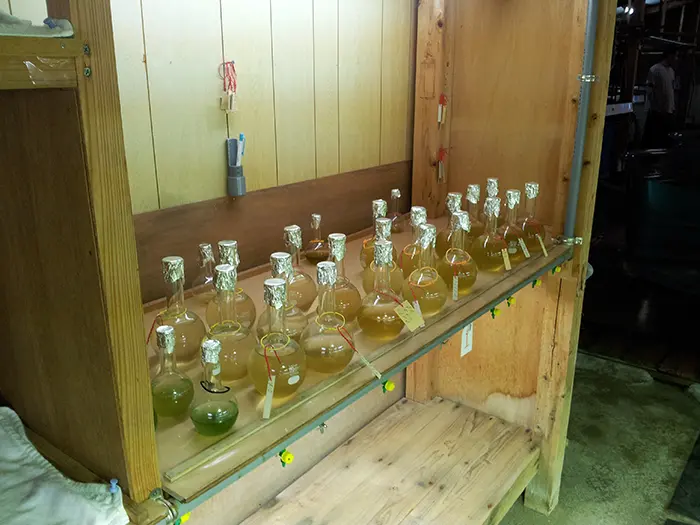
Plankton cultured as feed for young Akoya oysters.
What it means for buyers
Expect fine Akoya to stay scarce. The official figures show no rebound yet: output has held near 12 tonnes since 2021, against about 20 tonnes a year in the 2010s.
Buy on specification, not on a name. Learn the vocabulary Japanese graders use — color, shape, size, luster (teri), nacre thickness (maki) and blemishes (kizu) — and ask what processing a lot has had.
Get closer to the source. Kobe is the center of Japan's pearl processing and export trade, and its next showcase is Japan Pearl Fair, 9–11 November 2026, where each exhibitor brings its own selection of Akoya, including rare necklaces and loose pearls.
Tell the story accurately. Scarcity, craft and care for the sea are a powerful narrative for customers. It works best when every claim in it can be checked.
FAQ
What happened for Akoya pearls at Vicenzaoro 2026? On 6 September, a session organized by Preziosa Magazine with leaders of the Japan Pearl Exporters' Association reintroduced the Akoya to European and US markets, with a focus on younger buyers. The book The Future of Akoya Pearl, edited by Paola De Luca, was presented.
Why are Akoya pearls scarcer than before? Japan's harvest has fallen from a peak of 130 tonnes in 1966 to about 12 tonnes a year since 2021. Since 2019, a newly identified virus and high summer water temperatures have hit the oysters.
Are Akoya pearl prices rising? Yes. According to the Pearl Standard 2025, the average unit price at Akoya joint sales nearly quadrupled between 2021 and 2024, and harvest prices reached an all-time high.
Who is George Kakuda? The president of the Japan Pearl Exporters' Association, which brought the Akoya story to Vicenzaoro.
Where can I buy Akoya pearls at the source? In Kobe, the center of Japan's pearl processing and export trade. The next Japan Pearl Fair runs there on 9–11 November 2026.
Final word
Vicenza heard a story about scarcity. The more interesting word in the title was "future". Japan's pearl industry wants the Akoya seen as a contemporary material: grown in living water, in shrinking quantities, by an industry that measures everything it does. Whether that story takes hold will be decided in design studios — and, this November, on the show floor in Kobe.