The Complete International Buyer‘s Journey: From a Japanese Pearl Farm to Japan Pearl Fair
Every strand on a Kobe counter has already traveled for years — through a quiet bay, a winter harvest and the hands of graders and matchers. Follow that road, and you will know exactly what you are buying.
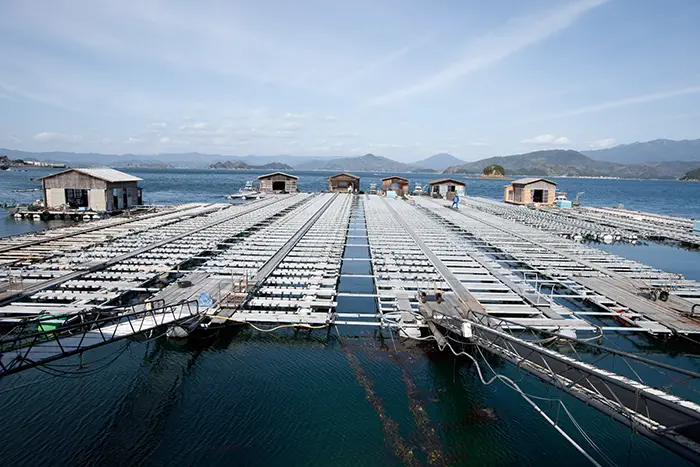
Pearl rafts on a calm Japanese bay.
A pearl necklace tells you very little about where it has been. It arrives clean, matched and finished, as if it had always looked that way. Yet a Japanese Akoya strand is the end of a long chain of decisions — about water, about oysters, about one delicate operation and one cold morning on a raft — made by people most buyers never meet.
This is that chain, link by link. It ends where many buyers' journeys begin: in Kobe, at Japan Pearl Fair.
The map: where Japan grows its pearls
Japan's Akoya come mainly from three prefectures in the west of the country. In 2024, Japanese farms produced 12,800 kg of pearls, according to agriculture ministry figures cited by JETRO: 5,800 kg in Nagasaki, 4,100 kg in Ehime and 1,800 kg in Mie. Together, those three account for more than 90% of the national harvest.
The names map onto a coastline of sheltered water: the islands of Tsushima in Nagasaki, the Uwa Sea off Ehime, the Ise-Shima coast in Mie. JETRO also notes what Japan's four distinct seasons give its pearls: more of them come out close to perfectly round than pearls from other countries, with color and teri — luster — that the market particularly admires.
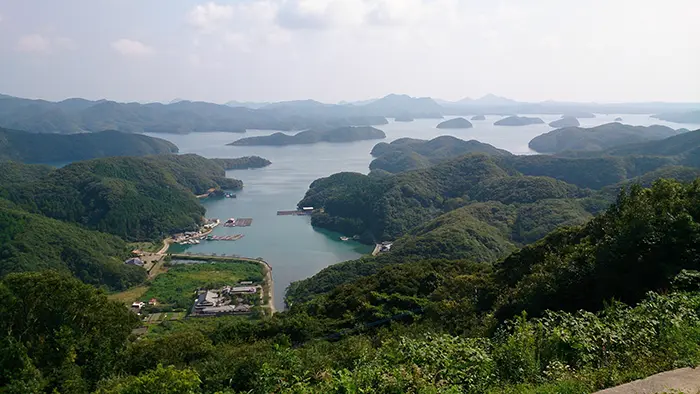
Aso Bay on Tsushima, Nagasaki Prefecture.
Step 1 — Raising the oyster
Before there is a pearl, there is an oyster, and a good one takes years to make.
Akoya larvae drift for two to three weeks after spawning before they settle, the Japan Pearl Exporters' Association explains. Today Japan's farms breed their oysters in hatcheries: by the 2000s, artificially bred mother oysters had become close to the only kind in use, according to the industry's Pearl Standard 2025. The oysters that will carry pearls are raised for about two years before the operation.
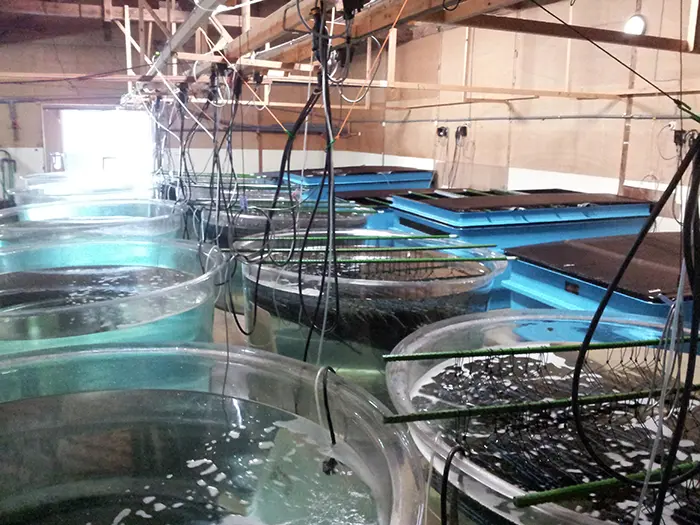
Hatchery tanks, where young Akoya oysters are bred.
Step 2 — The operation
The moment that defines a cultured pearl lasts seconds. A technician places a round bead nucleus inside the oyster together with a small piece of mantle tissue taken from a donor oyster. That tissue forms a pearl sac around the bead and begins to coat it, layer by layer, with nacre.
Japan made this possible. The technique for round cultured pearls was developed in 1907 by Kokichi Mikimoto, Tokichi Nishikawa, Tatsuhei Mise and their collaborators, who filed a series of patents on it. Because the operation is so delicate, Akoya culture grew into an industry unique to Japan, Hyogo Prefecture notes.
Afterwards the oysters rest for about a month in baskets in calm inner waters, and their shells are cleaned with care.
Step 3 — One to two years at sea
Back in the bay, each oyster grows its pearl for one to two years. Farmers keep cleaning the shells and watching the water.
That water has become harder to manage. Since 2019, mass die-offs of young Akoya oysters have hit Japan's main growing areas. In 2022, researchers identified a new virus as the cause, while high summer water temperatures and other stresses add to the toll, according to Japan's agriculture ministry. Japan's harvest has hovered around 12 tonnes a year since 2021, the Fisheries Agency reports. Every Akoya that reaches a buyer has come through that.
Step 4 — The winter harvest
Harvest — hamaage — usually comes in midwinter, when the sea is coldest and the pearls' color and teri are at their most vivid.
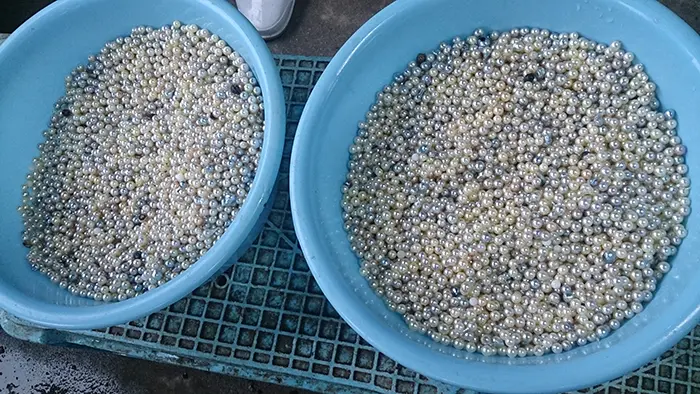
On the work rafts, the pearls are taken from the shells by hand and washed. Pearls unfit for sale are set aside at once. What remains is raw material: beautiful, uneven, not yet a product.
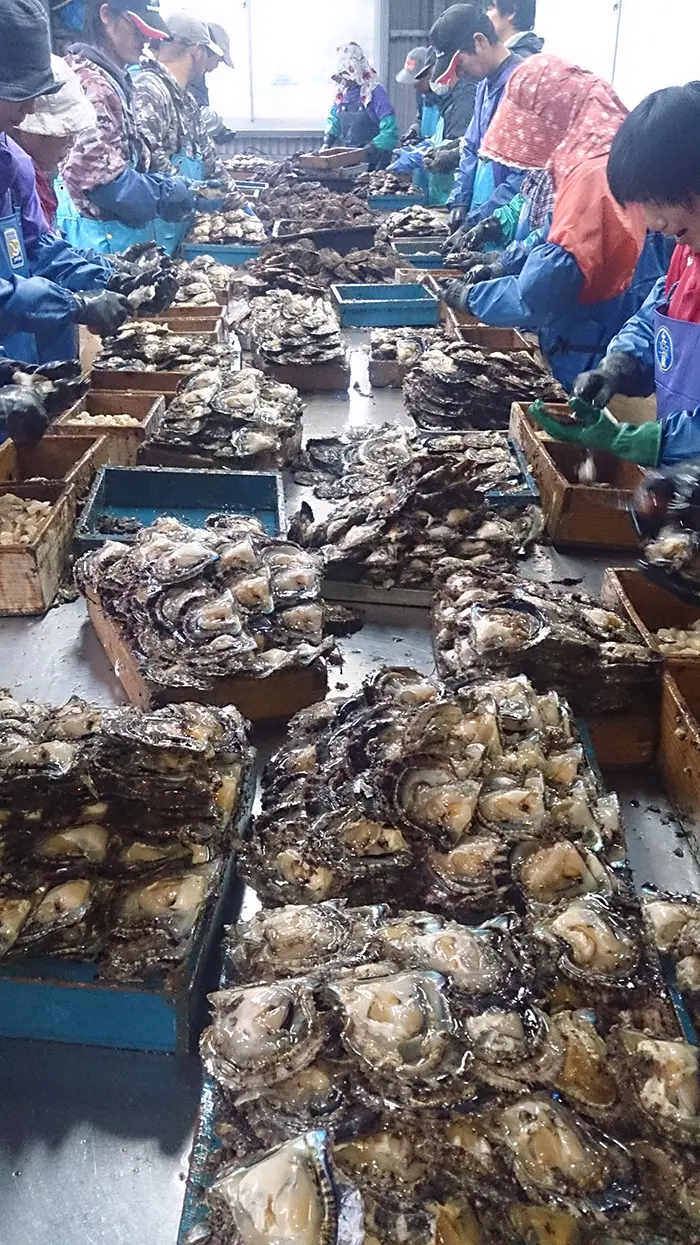
Harvest: pearls are taken from the shells by hand.
Raw pearls, just out of the shell.
Step 5 — Tender season
From January to March, tenders take place across Japan, and the harvest passes to wholesalers — the processors and distributors who will turn it into product.
At the tenders, pearls are sorted into first and second grades, then divided again by size, color, shape and blemishes before they are sold, the Fisheries Agency describes. Low-quality pearls are not sold at all; they are discarded or recycled as nuclei. This is a pearl's first market, and its first verdict.
Sorted: the harvest divided by size and quality.
Step 6 — Kobe: where pearls become product
Next comes processing: stain removal (shiminuki), color adjustment (chÅÂshoku) and drilling. The pearls then become loose lots or strands on a temporary thread, matched by size and color. Each company treats its processing know-how as a closely held secret.
Matching — rengumi — is slow, exacting work, and it needs good light. That is part of Kobe's story: the steady natural light between the mountains and the sea suited drilling and matching, Hyogo Prefecture records. Kobe processes South Sea and Tahitian black pearls from abroad as well, and about 80% of Japan's pearl exports leave through the city.
Quality control has deep roots here. From 1952 until 1998, pearls could only be exported after a state inspection in Kobe or Tokyo, graded H (high) or L (low). Since 1999, the Japan Pearl Exporters' Association has run a voluntary inspection on the same basis, tagging every strand that passes.
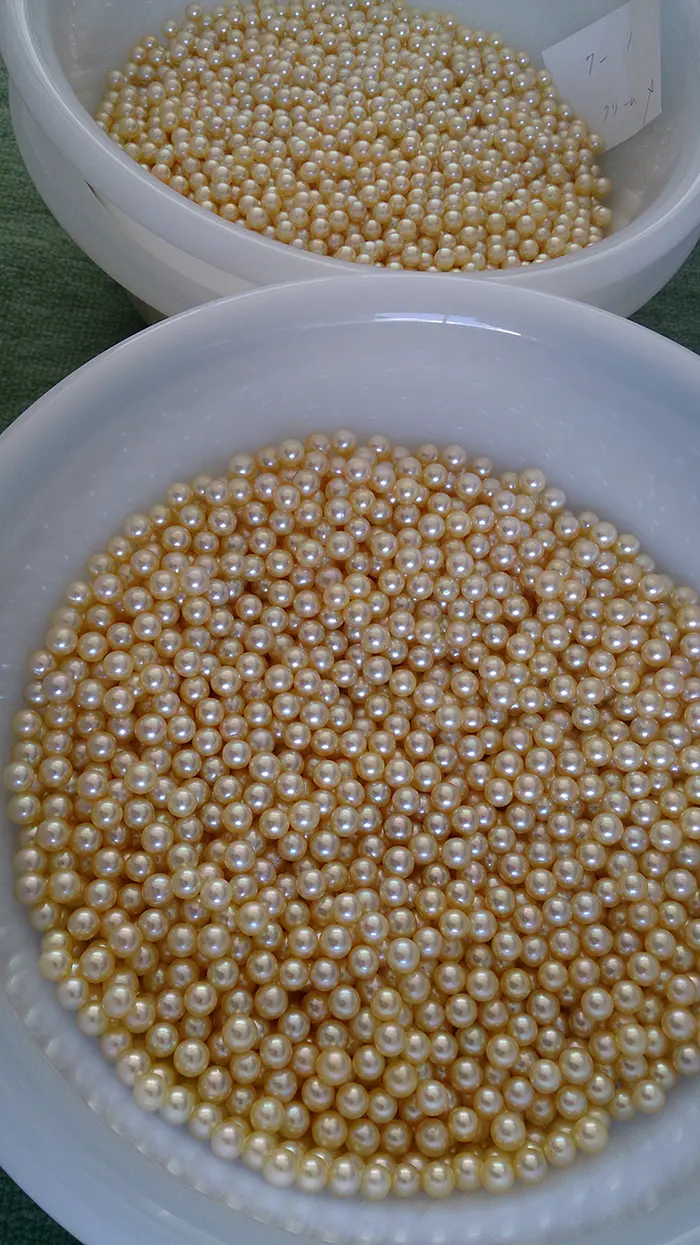
Selected pearls, ready for processing.
Step 7 — The fair: where the chain meets the buyer
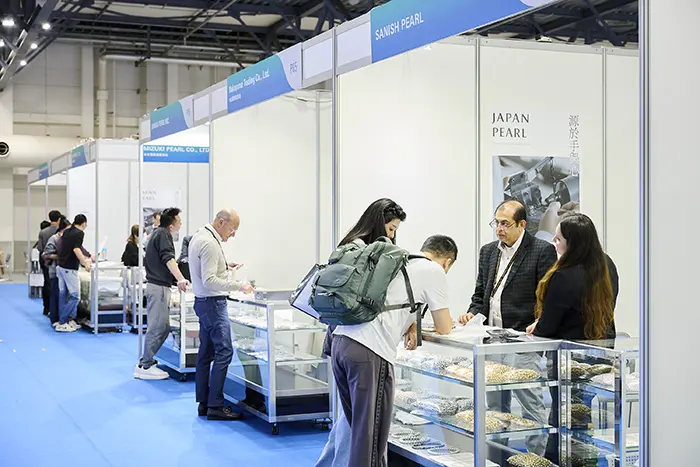
At Japan Pearl Fair, the end of this chain is laid out in one hall. More than 100 Japanese pearl companies exhibit in Kobe, with Akoya, South Sea and Tahitian black pearls processed with Japanese expertise. Pearl Expert Concierges guide buyers to what they need, and those who cannot travel can book online meetings with exhibitors.
For a buyer, this is the shortest road to the source. You see the work of many houses side by side, and you can put your questions to the people who made the choices.
Questions that trace a pearl
1. Where was this lot grown — which prefecture, which bay?
2. Which harvest is it from?
3. What processing has it had?
4. How was the strand matched, and how close are size and color?
5. Which grading terms are you using, and on whose standard?
6. Can you repeat this lot next season?
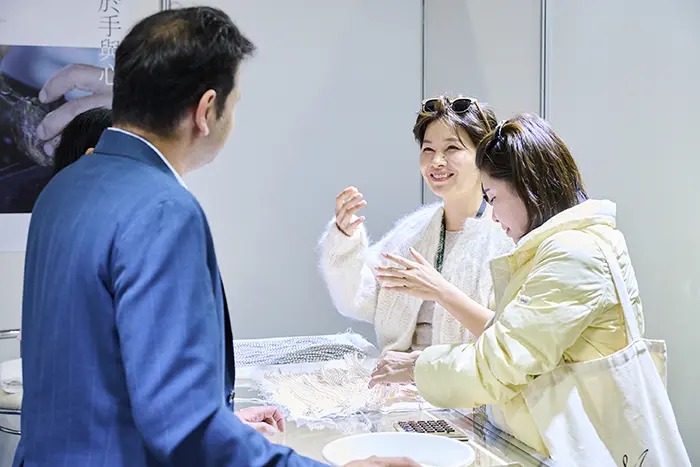
At the fair: the final choice is the buyer's.
If you want to see a farm
Production farms are working sites, not showrooms. If seeing one matters to you, start with the companies you trade with: the people who sell you pearls are the ones who can open that door.
FAQ
How long does it take to grow an Akoya pearl? The oysters are raised for about two years before the operation. After nucleation, the pearl grows in the sea for one to two years.
When are Akoya pearls harvested? In midwinter, when the water is coldest. Tenders follow from January to March.
Where are Akoya pearls farmed in Japan? Mainly in Nagasaki, Ehime and Mie, which together produce more than 90% of Japan's harvest.
Why are pearls processed in Kobe? Kobe has been the center of Japan's pearl processing and export trade for generations. About 80% of Japan's pearl exports leave through the city, and it processes South Sea and Tahitian black pearls as well as Akoya.
Where can buyers see this supply chain in one place? At Japan Pearl Fair in Kobe, 9–11 November 2026, or through its online business meetings.
Final word
A pearl's journey is measured in years and in hands. By the time a strand reaches a counter in Kobe, it has been chosen again and again — at the tender, at the sorting table, at the matching bench. The buyer makes the last choice. Make it knowing the others.
Register: japan-pearlfair.com/en