Japan Pearl Fair 2026: A Complete Guide for International Jewelry Buyers
Three days, one hall on Kobe's Port Island and more than a hundred Japanese pearl companies. How to plan the trip like a professional — from registration to the last strand you take home.
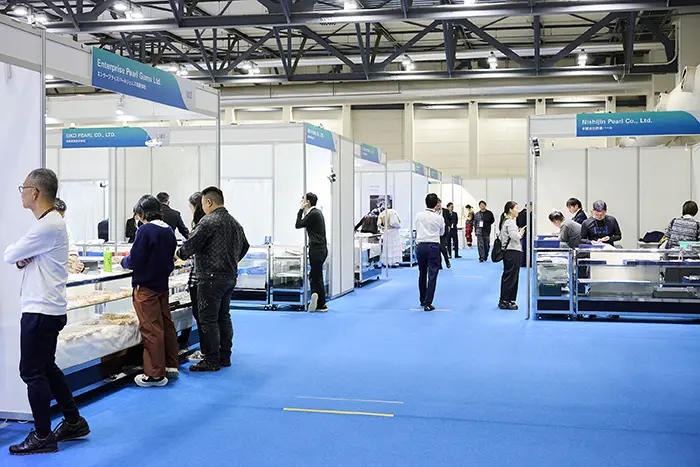
The show floor at the 7th Japan Pearl Fair, Kobe International Exhibition Hall, November 2025.
Most jewelry fairs make you walk past watches, diamonds and display cases to find the one thing you came for. Japan Pearl Fair works the other way round. For three days in November, an exhibition hall on Kobe's Port Island is given over to a single material — and to more than a hundred Japanese companies whose business is to find it, grade it, match it and ship it.
That focus is the point. If pearls are a line in your collection rather than an afterthought, this is where you can compare Akoya, South Sea and Tahitian black pearls side by side, from many suppliers, in a single day. Here is everything to settle before you book a flight.
At a glance
|
Detail |
Japan Pearl Fair 2026 |
|
Dates |
9–11 November 2026, Monday to Wednesday |
|
Hours |
10:00–17:00; closes at 16:00 on 11 November |
|
Venue |
Kobe International Exhibition Hall, Hall 3 — 6-11-1 Minatojima-nakamachi, Chuo-ku, Kobe |
|
Admission |
Free; advance registration required |
|
Format |
Hybrid: on site in Kobe, or online business meetings |
|
Who can attend |
Trade professionals; visitors under 16 are not admitted |
|
Exhibitors |
More than 100 Japanese pearl companies |
|
Organizer |
Japan Pearl Promotion Society (with the Council for Strengthening Collaboration of the Pearl Industry) |
What Japan Pearl Fair is — and who it's for
Japan Pearl Fair is a business-to-business exhibition devoted entirely to pearls. The Japan Pearl Promotion Society organizes it, the Japan Pearl Exporters' Association is a partner, Japan's trade agency JETRO cooperates, and Hyogo Prefecture and the City of Kobe lend their support.
The fair is young and moving quickly. It opened in Kobe in October 2022 as Pearl Industry Fair Japan, with more than 70 exhibitors. It has since taken the name Japan Pearl Fair and now runs twice a year: the eighth edition took place in June 2026, and November's is the ninth.
It is built for people who buy pearls for a living — jewelry brands and designers, wholesalers, retailers and specialist buyers.
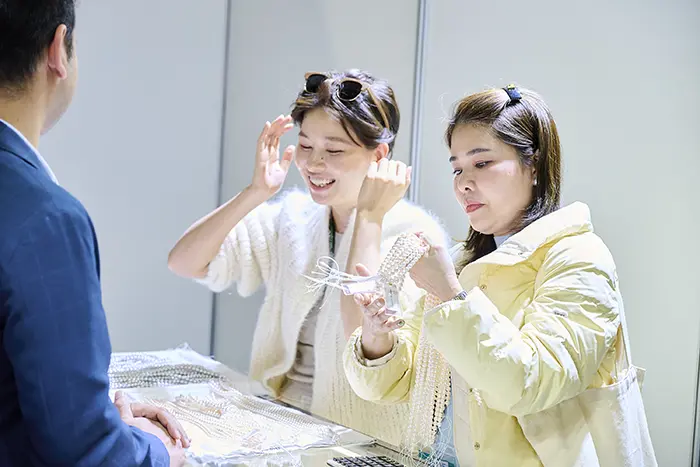
Trying pearls at an exhibitor's booth, November 2025.
What you can source in Kobe
Japanese Akoya pearls. The pearl Japan is famous for, and the one it produces most: the majority of the world's Akoya come from Japan. According to the Japan Pearl Exporters' Association, sizes run mainly from 2 to 11 mm, and natural colors range from white and pink to green, rosé, cream, yellow, gold and blue. The organizers promise rare Akoya necklaces and loose pearls, chosen by each exhibitor.
South Sea pearls. Larger pearls, mainly 8 to 18 mm, grown in Australia, Indonesia, the Philippines and other warm waters, in whites, silvers, golds and creams.
Tahitian black pearls. Mainly 8 to 15 mm, most from French Polynesia, in colors from black to blue, green, red and brown.
Why does a Japanese fair carry pearls grown elsewhere? Because Kobe processes them. Pearls from Australia and French Polynesia come to the city for Japanese processing, and South Sea and Tahitian pearls together make up about 60% of Japan's pearl exports, with Akoya at about 30%, according to Hyogo Prefecture.
Expect loose pearls, matched strands and finished necklaces.
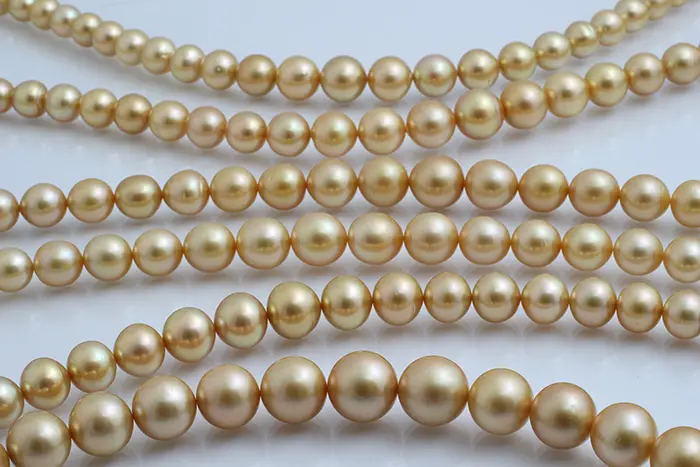
Golden-toned strands.
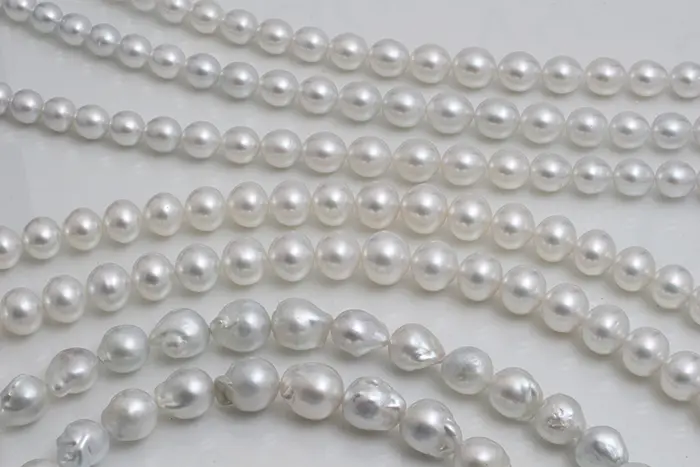
White baroque strands.
Sparkiya tip. Arrive with a written brief: pearl type, size range, shape, color, quantity and target price. In Japan's pearl trade, weight is often counted in momme — one momme is 3.75 g — so know your numbers by the piece and by weight.
Before you fly: registration, the free hotel and entry to Japan
Register in advance. Admission is free, but you must register first. Two forms opened on the official site on 11 September 2026: Onsite-visit Buyer Registration for those coming to Kobe, and Online Meeting Registration for those who cannot travel.
The free-hotel offer. The organizers are offering free rooms to the first buyers who register, up to 50 rooms. The published conditions:
• only buyers traveling from overseas are eligible;
• a transaction of USD 30,000 or more during the fair is required;
• one companion per room stays free;
• to cancel, contact the event office at least three days before check-in; a no-show without notice rules you out of a free room at the next fair.
Large orders earn a second reward: overseas visitors who present an invoice of USD 50,000 or more at this edition qualify for free accommodation at the next fair.
Entry to Japan. Visa rules depend on where you live, so check Japan's Ministry of Foreign Affairs before booking. The organizers also recommend registering on Visit Japan Web, the government's online service for immigration and customs, before you travel.
Questions? The secretariat answers at japan-pearlfair@ml.screen-cre.co.jp or +81 80-2487-5381, on weekdays from 10:00 to 12:00 and 13:00 to 16:00 Japan time, except public holidays.
Getting to Kobe — and to Hall 3
The exhibition hall stands on Port Island, a short ride from central Kobe. Your stop is Shimin Hiroba on the Port Liner line. An upper-level walkway links the station to the exhibition halls and to the Kobe Portopia Hotel next door.
|
From |
Route |
Time, approx. |
|
Kansai International Airport (KIX) |
Bay Shuttle ferry to Kobe Airport, then Port Liner to Shimin Hiroba |
30 min + 8 min |
|
Kansai International Airport (KIX) |
Limousine bus to Sannomiya, then Port Liner |
70 min + 8–10 min |
|
Osaka International (Itami) Airport |
Limousine bus to Sannomiya, then Port Liner |
40 min + 10 min |
|
Shin-Kobe station (Shinkansen) |
Subway to Sannomiya, then Port Liner |
2 min + 10 min |
Times are from the fair's access page; allow extra for connections.
How to work the floor like a professional
More than a hundred exhibitors is a lot of ground for three days. A plan helps.
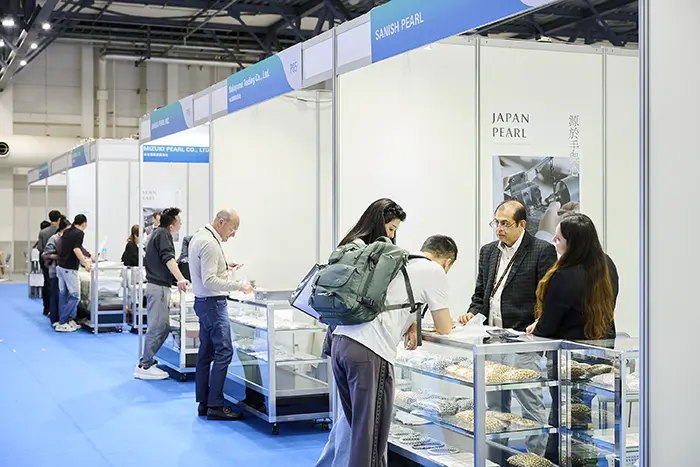
Exhibitor booths at the 7th Japan Pearl Fair.
Start with the concierges. The fair's Pearl Expert Concierges guide visitors to the products they are looking for and help with the purchasing process. Hand them your brief on day one.
Give each day a job. Day one: walk the hall and shortlist. Day two: compare strands side by side, ask questions and negotiate. Day three: confirm orders and paperwork — the hall closes at 16:00.
Speak the grader's language. Japanese graders look at six things: color (iro), shape (katachi), size, luster (teri), nacre thickness (maki) and blemishes (kizu). The rarest top-grade Akoya are called hanadama — "flower pearls". If a lot is offered as hanadama, ask which criteria stand behind the word.
Ask what a pearl has been through. After harvest, pearls are processed — stains removed, color adjusted, holes drilled, strands matched — before they reach a buyer, as Japan's Fisheries Agency describes. The industry's own Pearl Standard 2025 names disclosure of treatments as one of its aims, so the question is professional, not awkward.
Judge luster in good light. Luster is what you pay for, and it changes with the lamp. Compare strands side by side, and near daylight when you can.
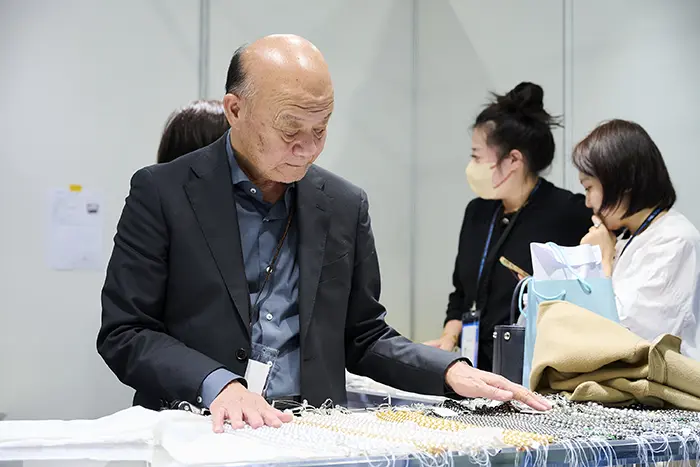
Strand by strand: comparing at the counter.
Can't come to Kobe? Use the online route
The fair is hybrid. If you cannot travel, register for online business meetings with exhibitors. Two house rules apply: meetings are arranged only between a registered buyer and an exhibitor, and livestream selling by visitors is not allowed.
Why Kobe
Kobe is not a backdrop. Customs figures cited by Hyogo Prefecture show about 80% of Japan's pearl exports leaving through Kobe since the mid-1970s.
The city's link with pearls goes back to the Meiji era, after its port opened. When the patents for round cultured pearls were made public in 1928, Kobe became the place where pearls were gathered and traded. In the Taisho era, processors settled around Kitano-cho and developed new polishing and drilling techniques; the steady natural light between the mountains and the sea suited drilling and matching. In 1952, Japan opened its national pearl inspection offices in Kobe and Tokyo, the Japan Pearl Exporters' Association records. Since 2003, international bonded tenders for pearls grown abroad — once held in Hong Kong — have taken place in Kobe about twice a year.
That is why the fair is here: many of the companies that do this work every day are minutes away.
Your checklist
• Register on the official site — onsite visit or online meeting
• Check whether you qualify for the free hotel (overseas buyer, transaction of USD 30,000 or more)
• Check visa rules and register on Visit Japan Web
• Write your brief: type, size, shape, color, quantity, budget
• Plan your route to Shimin Hiroba station
• Watch the eighth edition's seminars on the fair's YouTube channel ("Japan Pearl Seminar: History, Quality, and Sustainability")
• Skim the Pearl Standard 2025 for vocabulary
• Keep the last afternoon free — the hall closes at 16:00 on 11 November
FAQ
When and where is Japan Pearl Fair 2026? 9–11 November 2026, 10:00–17:00 (until 16:00 on the last day), at Kobe International Exhibition Hall, Hall 3, on Port Island in Kobe.
Is it free? Yes. Admission is free, but advance registration on the official site is required.
Who can attend? Pearl and jewelry trade professionals. Visitors under 16 are not admitted.
What pearls can I buy? Japanese Akoya pearls, South Sea pearls and Tahitian black pearls — loose, in strands and as necklaces.
Is there free accommodation for overseas buyers? Yes, for the first registrants, up to 50 rooms. You must travel from overseas and complete a transaction of USD 30,000 or more at the fair.
Can I take part without traveling to Japan? Yes. Register for online business meetings with exhibitors.
How do I get there from Kansai Airport? Take the Bay Shuttle ferry to Kobe Airport (about 30 minutes), then the Port Liner to Shimin Hiroba (about 8 minutes).
How often is the fair held? Twice a year. In 2026, the eighth edition took place in June and the ninth runs in November.
Final word
Pearls reward people who look closely. Kobe in November gives you three days to do exactly that: to hold strands from different houses under the same light, to ask the questions a catalogue cannot answer, and to meet the people you may be buying from for years. Register early, travel with a brief, and keep the last afternoon free.
Register: japan-pearlfair.com/en