Raden (螺鈿): The Ancient Japanese Art of Mother-of-Pearl That Is Redefining Modern Jewelry
There is a moment, when you hold a piece of Raden jewelry in your hands and tilt it toward the light, when something extraordinary happens. The surface shifts. Greens bleed into blues, blues dissolve into violet, violet melts into gold — all without any pigment, any dye, any digital manipulation. Just light, shell, and over a thousand years of human patience.
This is Raden (螺鈿). And it may be the most visually remarkable jewelry technique that most of the world has never heard of.
What Is Raden? The Technique Explained.
Raden is the Japanese craft of embedding ultra-thin slices of mother-of-pearl shell into lacquer or wood to create iridescent, light-catching surface decoration. The word itself breaks down simply: "ra" (螺) means spiral shell, and "den" (鈿) means decoration with shell or metal. Together they describe exactly what the technique does — it transforms the inner lining of certain mollusks into wearable, functional art.
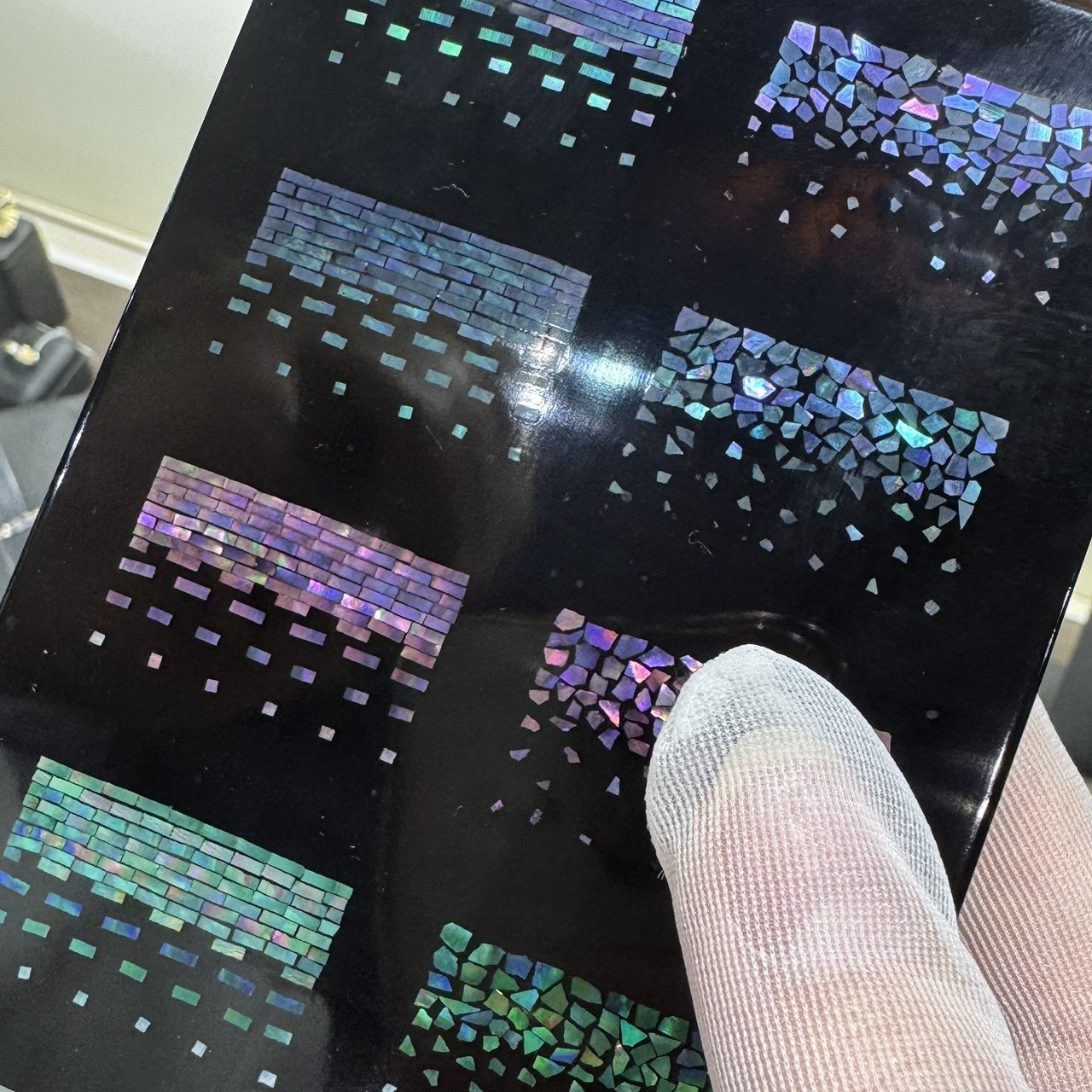
The iridescence is not an artistic effect — it is physics. The inner layer of shells like abalone, pearl oyster, turban, and nautilus is composed of nacre: a microscopic layered structure that interferes with incoming light, splitting it into the full visible spectrum. When you cut nacre into thin wafers and embed it into a dark lacquer surface, every movement creates a new color. No two viewing angles produce the same result. No two pieces ever look identical.
In practice, the process is extraordinarily demanding. Shell pieces are ground down on both sides until a translucent wafer remains. Depending on thickness, these wafers are classified differently: pieces between 0.1 and 2 millimeters are called "atsugai" (thick shell), while those under 0.1 millimeters are "usugai" (thin shell). The thinnest pieces — nearly transparent — allow the dark lacquer underneath to show through, creating a deep blue-black glow known as "aogai-nuri". The finest shell fragments can even be pulverized into iridescent powder called "mijingai", used to dust surfaces with a shimmer that catches light like crushed stars.
Each shell piece is then cut by hand using a scroll saw, precision knife, punch templates, or acid etching — shaped to fit a design that may involve hundreds or thousands of individual fragments. They are inlaid into the lacquer surface, sealed with additional lacquer coats, and burnished by hand until the surface is mirror-smooth. A single pair of Raden chopsticks can take four months to complete. A piece of Raden jewelry — with its curved surfaces, intricate forms, and miniature scale — demands even more.
3,000 Years of History: From Egypt to the Imperial Court of Japan.
The origins of mother-of-pearl inlay stretch back further than most people realize. The technique is believed to have first appeared around 3,000 BCE in ancient Egypt, where nacre was used to decorate furniture and ceremonial objects. From there it traveled east through the ancient world, reaching China during the Yin dynasty as early as 1700 BCE, and flourishing further along the Silk Road through exchanges with the Sassanian Empire of Persia.
Japan's encounter with Raden came during the Nara period (710–794 CE), when Japanese envoys dispatched to Tang China returned home carrying treasures adorned with mother-of-pearl inlay. Among the artifacts that survived this cultural exchange is the exquisitely crafted "Eight-lobed bronze mirror decorated on the back with mother-of-pearl inlay," now enshrined among the Shosoin treasures at Nara's Todaiji Temple — one of Japan's most sacred repositories of imperial heritage objects.
What Japan did next was not simply imitation. Japanese craftsmen took the technique from wood — where it had been practiced in China — and began embedding it into lacquer, creating an entirely new aesthetic tradition. The result was uniquely Japanese: deeper, more luminous, more refined.
During the Heian period (794–1185 CE), Raden became a defining element of Japanese imperial court culture. It adorned the most precious objects of noble life — inkstone boxes, lidded chests called "karabitsu", musical instruments, and decorative screens. It was used alongside "maki-e" (lacquer decorated with gold and silver powder) to create objects of extraordinary complexity and beauty. Raden lacquerware from this period defined Japanese national artistic identity and remains among the most treasured works in the world's great museum collections.
By the Kamakura period (1185–1333 CE), the technique had expanded beyond the imperial court. Samurai culture embraced Raden as a mark of status and power — elaborate saddles decorated with mother-of-pearl inlay became symbols of warrior prestige, turning even military equipment into works of art.
Centuries later, in 1999, the Japanese government formally designated Raden as an Important Intangible Cultural Heritage — one of the highest protections a traditional craft can receive in Japan.
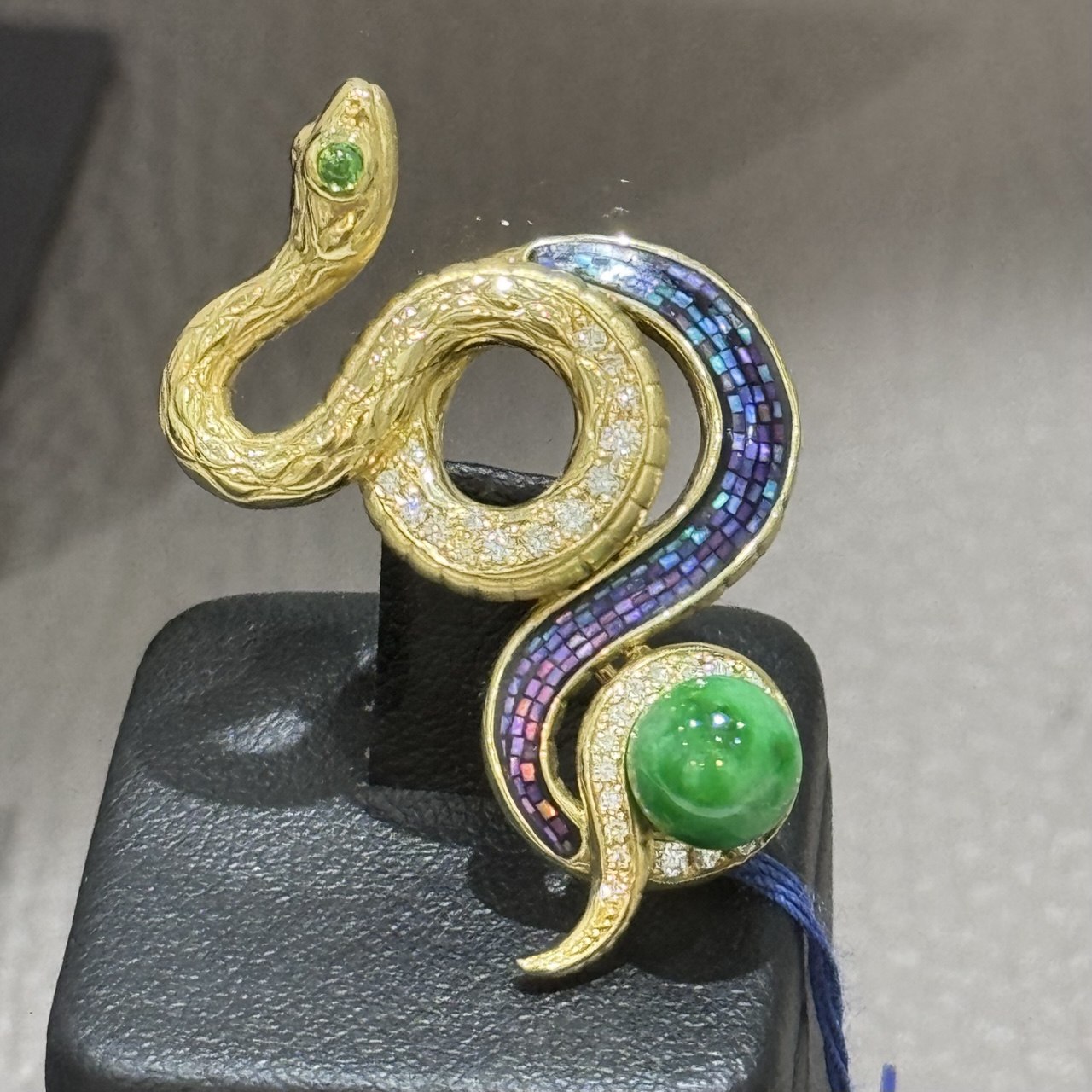
Handcrafted by designer Ito Keiko, Japan
The Raden Revival: From Temple Altars to Fine Jewelry
For much of its history, Raden lived in the domain of lacquerware — applied to furniture, boxes, decorative objects, architectural elements. The ceiling of the Phoenix Hall at Byodoin Temple near Kyoto, one of Japan's UNESCO World Heritage sites, features Raden inlay. Imperial household objects, temple altarpieces, and samurai armor carried its shimmer through the centuries.
But jewelry? That chapter is being written now.
A new generation of Japanese designers and artisans is taking this sacred technique — its tools, its materials, its philosophy of patient precision — and translating it into contemporary fine jewelry. Rings, pendants, earrings, and bracelets that carry the same mother-of-pearl shell, the same lacquer, the same hand-cut fragments that once decorated imperial palaces. But now worn on the body, in motion, catching light with every gesture.
The shift makes aesthetic sense. Jewelry is one of the most intimate objects a human being can carry — and Raden's defining quality, that constant, living change of color with movement, is made for the body. A Raden ring on a moving hand is never static. A Raden pendant at the neck catches different light every moment. The technique, which spent a thousand years decorating objects designed to sit still in palace rooms, finds a new vitality when it moves with a person through the world.
At the Japan Jewellery Fair, exhibitors like "Jewelry of Raden & Urushi" represent this growing movement — artisans who have spent years mastering traditional lacquer craft and are now bringing that knowledge into the contemporary jewelry market. Their work occupies a rare intersection: technically it belongs to the world of traditional Japanese craftsmanship; aesthetically it speaks to the most current conversations in international fine jewelry about uniqueness, materiality, and the value of the hand-made.
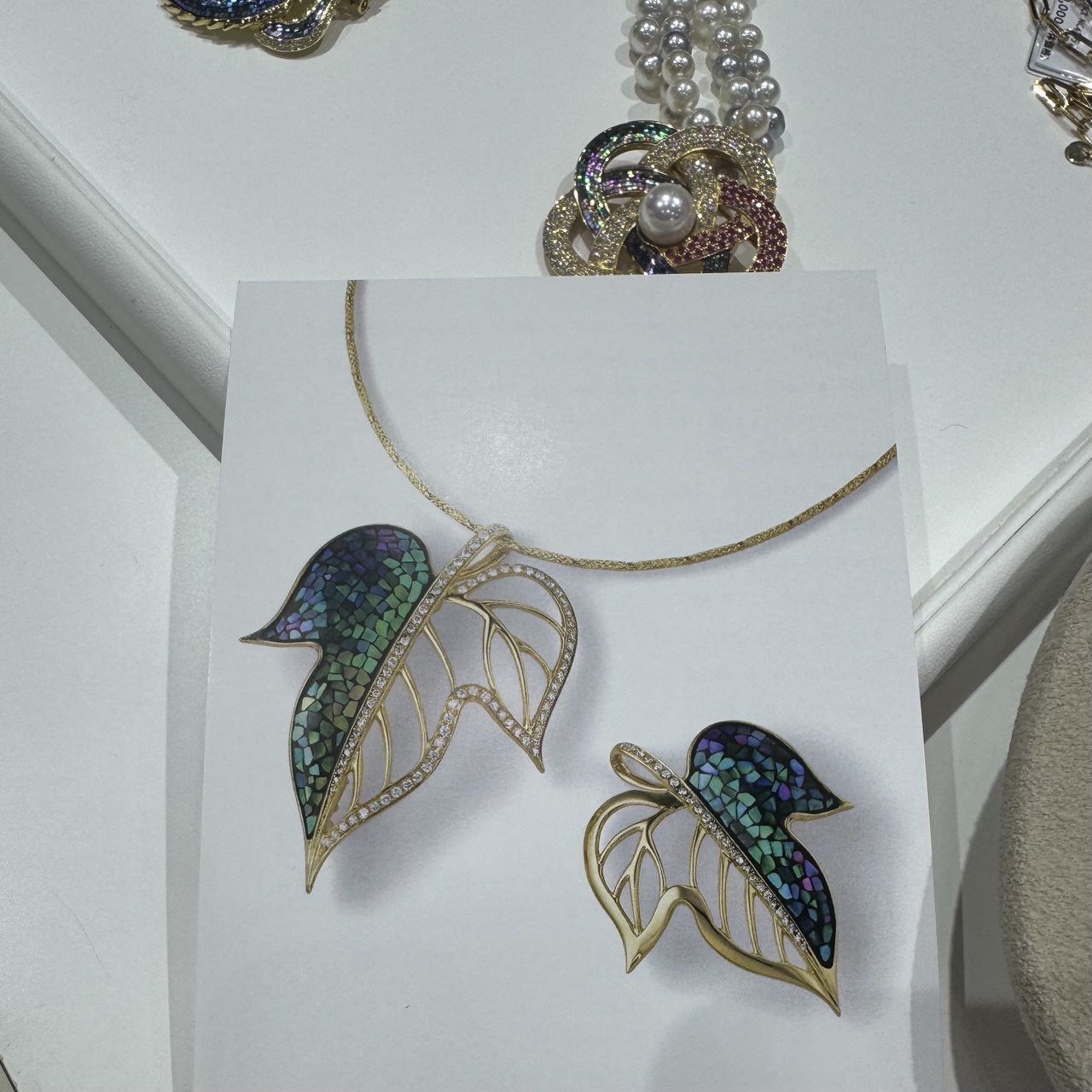
Handcrafted by designer Ito Keiko, Japan
Why Raden Matters Now: The Global Context
The timing of Raden's emergence in fine jewelry is not accidental. The international jewelry market is in the middle of a significant shift in values.
Across every major market — from the US to Europe to the Middle East — the most informed jewelry buyers are moving away from mass-produced luxury toward pieces with genuine story, genuine craft, and genuine uniqueness. They are asking not just "how beautiful is this?" but "what is the story behind it? Who made it? How? With what?"
Raden answers every one of those questions with unusual depth. The technique has an unbroken lineage stretching back over a thousand years in Japan. It requires skills that take years to develop and cannot be replicated by machine. Every piece is genuinely unique because every shell fragment is unique — no two pieces of nacre catch the light identically. And the cultural story behind it — imperial courts, samurai culture, UNESCO heritage status, the Shosoin treasures — provides a narrative that no synthetic material or mass-production process can compete with.
Japan's jewelry market in 2025 and 2026 is increasingly defined by this same philosophy. As noted in recent market analysis, Japanese consumers and designers are moving toward pieces that "tell a personal story" and reflect "cultural significance" — away from generic mass-produced items and toward works that carry genuine identity. Raden jewelry sits at the center of this movement. It is Japanese, it is ancient, it is irreproducible, and it is visually unlike anything else on the global market.
For international buyers attending exhibitions like IJT (International Jewellery Tokyo), Raden jewelry represents one of the clearest opportunities to source something genuinely exclusive — a piece that cannot be found in any other market in the world, made using a technique that exists nowhere else with this level of refinement.
How to Recognize Quality Raden Jewelry
Not all Raden work is equal, and understanding what distinguishes a masterwork from a lesser piece is valuable for both buyers and collectors.
Shell quality and species — The finest Raden jewelry uses abalone shell ("awabi") for its exceptional depth of color and complexity of iridescence. Pearl oyster shell produces a cleaner, more silvery shimmer. Each species creates a different visual character, and experienced craftsmen select their materials with the final aesthetic in mind.
Thickness and translucency — The thinnest shell pieces ("usugai") allow the dark lacquer beneath to show through, creating the deep, almost supernatural blue glow that is the hallmark of the most refined Raden work. Thicker pieces ("atsugai") produce a more opaque, jewel-like quality. Both are legitimate and beautiful; the difference is one of aesthetic intention, not quality.
Precision of cut — Examine the edges of the shell fragments under good light. In high-quality work, the cuts are clean and precise, fitting together with the exactness of a mosaic. The boundaries between fragments reveal the skill of the craftsman.
Surface finish — The final burnishing is critical. A masterwork should have a surface so smooth it feels like glass, with no sense of the layers beneath. The shell should appear to float inside the lacquer, not sit on top of it.
Uniformity of color shift — In a well-made piece, the iridescence shifts gradually and evenly across the surface as the viewing angle changes. Inconsistent or patchy color variation may indicate uneven shell thickness or inconsistent lacquer application.
Where to Find Raden Jewelry in Japan
For those seeking to encounter Raden jewelry in person, Japan offers several access points.
Major trade exhibitions including the Japan Jewellery Fair and International Jewellery Tokyo (IJT) regularly feature exhibitors working with traditional lacquer techniques including Raden. These are the best places to meet the artisans directly, understand their process, and source pieces with full provenance.
Specialist craft galleries in Kyoto — particularly in the Nishiki Market area and along Teramachi Street — often carry Raden lacquerware and occasionally jewelry from regional artisan workshops. The Wakasa region of Fukui Prefecture, which has maintained Raden lacquerware traditions since the early Edo period, is a destination for those willing to travel beyond Tokyo.
For international buyers, the most reliable path to authentic Raden jewelry remains working with a specialist who understands both the craft tradition and the contemporary market — someone who can verify provenance, explain the technique, and ensure that what you are buying is genuine hand-crafted work rather than a machine-produced imitation.
A Living Art
There is a quality to Raden jewelry that photographs cannot fully capture and words can only approximate. It must be seen in motion — held in a moving hand, worn at a changing angle to the light — to reveal what it actually is.
What it actually is: a material that has spent over a thousand years in Japanese culture, moving from imperial courts to samurai saddles to temple ceilings, and arriving now — for the first time — on the bodies of people who wear it through a modern world.
The ancient technique and the contemporary form are not in conflict. If anything, Raden was always waiting for this. It was always a technique about light and movement, about surfaces that live and change. Jewelry simply gives it the ideal canvas: a body in motion, in light, in the world.
This is what modern Japanese jewelry looks like at its most extraordinary. This is Raden.
TAGS: Raden, 螺鈿, Japanese jewelry, mother of pearl, Japanese lacquer, traditional crafts, Japan jewelry market, fine jewelry, artisan jewelry, MadeInJapan, Japanese craftsmanship, jewelry culture